Sunday, November 6, 2011

Transition into Nepal (Carolann's Story)

(This and other stories by Carolann can be found at Maturetraveler)


My years in government have taught me to be prepared. Have contingency plans. Carry a barf bag.


The first indication that it would be a trying day was at the business class check-in counter when I fell to the floor and started vomiting into a plastic bag. I hurled and hurled in front of the line-up in the Bhutan International departure lounge. Certainly this was a new low in humiliation for me.


The attendants were very helpful. I was escorted to the lounge where I regained my strength. Our passports and boarding pass were delivered to us there.


I had felt nauseous even the night before, perhaps out of a combination of stress and bad food. Dan and I had just climbed to 10,000 feet to visit Bhutan's famous Tiger's Nest monastery. The climb was harder than we supposed, but I took it very slowly, a pace that suited my back and congested lungs. The goal was to finish the climb. By that time, one monastery had started to look like another. This one just happened to dangle three thousand feet above a shaved cliff face.


On the way down, Dan and our guide went ahead. It was past 1:30 and Dan's internal lunch alarm puts him in overdrive. I continued to inch along slowly, watching my feet to keep steady and gripping the rock face as best I could. I got into the moment by mumbling a song to myself, better than counting steps.


I was so focused in my descent that when I looked around me, no one was behind me. A German couple appeared around the next bend and told me I had already passed the cafeteria cut-off at least 15 minutes ago.


Angry and depressed, I decided there was no way I was going to struggle upwards again. I did it once, at pain (I took three hours rather than the normal two hours), and I was not going to do it again. Our guide should have been watching for me at the turnoff.


My plan therefore was to descend quickly and tell the driver who waited with our car to call our guide's cell phone. Of course Dan would be sick with worry since I had been so wobbly for much of the way up.


But contingency plans sometimes fail. Along the way I met a Buddhist nun walking with two sticks and favouring her knees. I spent the rest of the descent, slower than planned, inching along with her, keeping her steady, admiring her gumption in even attempting the climb. She had only made it as far as the cafeteria but that's a significant accomplishment. She had descended alone while her companions ate lunch so she would not hold up the group. I suddenly felt ashamed of my lack of consideration for my own companions.


I met our driver on the path. The guide had called him in a panic and asked that he start climbing to look for me. Our guide himself had returned up to the monastery to look for me. When I was found, Dan and our guide both came rushing down the mountain as fast as possible.


So that's the context. I made everyone sick with worry, and in a stroke of divine justice, I fell ill myself overnight.


I know from experience that travelling when you're unwell is best avoided, but our visas were expiring the morning after our climb. Our tickets were complicated in that we would be connecting in Kathmandu, Nepal to a domestic flight for Pokhara. Hotels were booked. The machine was in motion.


Dan took the window seat so one of us could enjoy the view. It was a glorious day high above the cloud cover and the Himalayas appeared on cue, and Everest, poor snow-barren Everest, burst above the clouds. Climate change is impacting the earth's tallest mountain. It's shockingly grey now as it won't hold its snow cap all year.


Normally, a safe landing gives me cause for quiet celebration. But this is Kathmandu. Does one give thanks when you arrive at the lowest level of Dante's hell? Yes, I've not been to India yet, but we've travelled through the urban carnage of Jakarta, been lost in Lima Peru. That should make for some experience. But it takes these kind of experiences in a new place to remind us that we really know nothing at all about the world. We've skimmed its pages, like pulp fiction.


Nepal is the 12th poorest country in the world with a literacy rate of about 50%. Thirty million people squeeze into a landmass the size of the state of Oregon (or a quarter of the size of Alberta) and you might as well reduce that area by three quarters since people mostly settle in the valleys. Like Bhutan, the country comprises the foothills of the Himalaya, foothills being huge tree covered mountains in themselves.


Unlike Bhutan which holds a trifling 700,000 people and is understandably infused with a sense of calm and peace, Nepal is a bubbling cauldron of small economic enterprise. Filthy stores showcase filthy wares, filthy used truck tires, corrugated metal sheets piled on filthy, brittle pavement, unhealthy cows wandering amidst motorcycles, and smoke-belching transport trucks fill the streets churning up clouds as dense as a scourge of locust, a blight to the urban landscape, if landscape is the proper word.


But I'm getting ahead of myself. We're still at the Kathmandu international airport.


We enter the passport control building and two wickets are open for travellers without visas.


Visa?


I feel that queasy feeling returning but I say to myself, "Keep Calm. Carry On."  After all, though I may be under the weather, the buzz of Bhutan's peace of mind remains.


We take our place in the line behind 200 people. It goes nowhere. Each transaction seems to take ten or more minutes. People are complaining that they have been waiting three hours. There's a visa form we fill out while standing and thankfully we each have extra passport photos. It's common enough that you can get a visa at the airport, but the processing system in other countries we've known (like Indonesia) is light years ahead of this mess.


An attendant is assisting people in the line by stapling their photo to the form. Dan has an idea.


He shows the attendant the tickets for our connecting flight and asks for us to be expedited. We need to reach the domestic terminal within thirty minutes in order to be there an hour ahead of the flight.


At first she is hesitant. Then she sees the Canadian flag on my carry-on and smiles wide. "You Canadian? You have visa money? I see passport." We give her the documents.


"Come here" and we are taken to the line up for diplomats and "special visas".


We remain hopeful although nothing happens. An agent is processing people ahead. He pulls out a drawer looking for something. He pushes it back. He stands up and cranes his neck to look around. He walks over to another station borrows something and returns to his desk. He leans over to a companion and waves a document and then straightens himself. Papers are handed over and the people are shuffled off to another agent for stage two.


I observe this lengthy, hesitant process and chuckle at how similar we all are in the natural world. My mind goes back to the Galapagos Islands. I close my eyes and watch once more as an albatross preparing to take off. We were standing at the cliff edge looking at Blue-Footed Boobies whipping around overhead when someone spots one of the great albatross birds walking towards our party. We part to make room for the bird that stands waist high. After tentative steps forward, then stopping, then forward, he reaches the cliff edge. Cameras raised. The bird sits down. Cameras lowered. The bird stands up. Cameras raised. The bird stretches out his wings in that magnificent seven-foot span. We hold our breath. Some cameras snap. The bird sits down. "Shit". The bird stands up once more, cranks its neck over the edge of the cliff. Cameras raised. The bird sits down. After fifteen minutes of playing with us, the bird stands erect, arches its wings and silently drops over the cliff.

Bang. Stamp. We are handed our visas. The albatross arches his wings.


But, not so fast.


We retrieve our luggage and pass on a taxi. It's a ten-minute walk across a field to the domestic terminal. We think we can do it. My stomach has settled. Besides, when you have to find the strength to do something, you do.


We cut our way through hundreds of people, taxi touts, beggars, dragging our luggage over chipped cement and then into the garbage-littered brown dirt and eventually push our way into the check-in counter. The checked luggage is just thrown into a pile behind the desk. There are no automated luggage belts. We are motioned towards a third scanner for our respective carry-on computer and camera cases and we separate into male and female lines where a woman will tickle my breasts and legs. My newly purchased water bottle goes through undetected. The detection activity is all show. Someone takes apart Dan's earphones and i-pod, demonstrating competence to his boss.


We funnel into the crowded departure lounge and sink into the last two plastic, black-stained barrel chairs that are not broken. I'm feeling drained and a bit nauseous. I take my last pill.


The albatross backs away from the cliff once more.

After two hours, we strain to hear a garbled announcement telling everyone that our flight is cancelled. All flights to Pokhara are cancelled. Visibility is poor. Come back tomorrow.


Time for some problem-solving.


But first, we need to return to the check-in desk to retrieve our luggage. Already 50 people are lining up and I take my place among them.


Dan is a wonderful travel companion. Very resourceful and scrappy when necessary. He simply walks behind the check-in agent, enters the back room behind a curtain and grabs our suitcases. They had remained there in a pile the whole time we had awaited the flight. I seriously doubt they would have ever joined our flight had it not been cancelled.


"We should go to the sister hotel in Kathmandu of the one we've booked in Pokhara. They can straighten things out and change our booking to here for tonight. Even if they are full, they can find us a place."


The idea is good, but finding the Sacred Valley Inn, Kathmandu is not easy. The address is in an e-mail in my computer and there's no internet service at the airport.

Keep calm. Carry on.

Dan remembers there's a tourist desk at the international terminal so we need to go back. This time however we find a flat-rate taxi desk and negotiate a fare that includes a stop at the international terminal.

Dan remains in the cab with our luggage and I dash into the airport. I'm prevented by security to re-enter the terminal where the full service tourist desk is located. I seek help instead from the kiosk outside. But first I scan the drivers holding signs to see, if by luck, someone is there from our hotel. The albatross has sat down.


I should have been suspicious of tourist kiosk personel who look like taxi touts. This man knows the hotel well so I get him to write down the name and directions in Nepalese so our driver can read it. I'm energized by this good luck.

Two hours later, in the warren of narrow streets, honking cars, choking exhaust, one cursing cyclist, our driver is seeking further directions. We had been led astray. I'm having difficulty breathing because of the stench. My stomach is churning once more. We see westerners on the street and call out from our stalled cab. "Please can you look up our hotel in your guide book. We are lost".

The two Germans came to our aid through the window of the car but our hotel is not listed. Dan then sees an internet cafe, dashes in there and within a few minutes has found proper directions to our hotel in an entirely different neighbourhood.


The day has indeed been trying.


At the desk of the Sacred Valley Inn, I start to explain our situation to the attendant and collapse backwards onto the couch. My strength has finally given out. They take me to another room, give me water. Dan takes over. We're a good tag team.


The hotel is entirely booked up.


Keep calm. Carry on.


It would still take another day before the albatross drops over the cliff. The hotel staff found us a room across the street, we had a good night sleep. The next day, our flight was rescheduled, then cancelled again. We elected to drive to Pokhara. It ended up being the only option since Nepal's domestic airlines have been shut down for five days now. We have found ourselves at the front end of a system of haze and rain showers unheard of in the month of November. Such is climate change. At this moment, 2,000 trekkers are being put up in tents by the army since they are unable to fly out. Hotels are full and food in the region is being trucked in.


Dan and I are resting in Pokhara. We can't trek. There's no mountain view, only white haze. But we need the rest. And in the end, our hosts at this small inn and those in Kathmandu have been outstanding in their service and support. A cheery red bougainvillea vine spills onto our terrace. There's a good vibe here.

But we need to decide by Tuesday where we'll go from here. In this case, it will indeed depend on which way the wind blows.

Monday, October 31, 2011

The Thai Art of Being (Carolann's Story)

(This and other stories by Carolann can be found at Maturetraveler)


We were in Thailand only briefly, just long enough to breathe it in, bathe in its humidity, and be touched by the Thai art of being.

 At the brilliantly designed Suvarnabhumi arrival hall, we walk through light-drenched hallways lined with intertwining metal spears as if we were migrating birds caught in a tubular bird-cage. Architecturally, more World Fair than airport, the building impresses with its balance of form and function. We move effortlessly through each station, customs, baggage, and money exchange.

Seeking the hotel pickup zone, we ask directions from a smiling, smartly dressed attendant. We receive a meaningless, confusing, if not a contradictory response to what our guidebook says. The attendant smiles, pleased to be of service, and closes her palms together is a soft bow.

 "Did you get any of that?"

"Haven't a clue."

 Based on our experience of a month roaming around the country some years ago, we understand Thailand to the extent that we know we will never understand the Thais. It doesn't matter and we don't get rattled about it. Thais want to please and will not say no, nor will they own up to not knowing an answer to a question you ask. Face saving is almost everything, and presentation is the rest.

 Still, if you gravitate to beauty in any form, singing language, sensuous movement, arresting aroma, artfully appointed hotels, someday you will find yourself in Thailand.

 At this point in time, we are merely transiting over 24 hours and have enough time in Bangkok to admire the precise arrangement of slippers beside our bed, down a welcoming glass of lemongrass water, enjoy dinner out, and make some necessary purchases in a shopping mall. The mall is so dazzling, we are drawn to this 21st century arena where consumption is boldly celebrated; we take it in like a spectator sport. Still, we need to remember we're looking for a pharmacy. Dan is under the traveler's curse and I'm coming down with a cold.

Transitions are tiring and I'm looking forward to reaching our next destination. And it's just as well we are leaving quickly. They are piling up sandbags on our street. Flood waters are rising in other parts of the city. Our hotel is about half way between the city centre and the new airport which itself is about thirty kilometres east of the centre (the old airport has already been closed by the floods). As other neighbourhoods prepare for the worst, the Suvarnabhumi airport is opening up its parking lots and roadway shoulders to people who want to protect their car from the floods.

It's classic Thai that the staff assemble to wish us a good journey, smile, and bow. I admire their jai yen, literally meaning 'cool heart'. The culture avoids raised voices, visible signs of irritation and confrontation of any kind. On this early morning, almost five years after their last natural disaster, the boxing day tsumani, it's as if these people are saying, "what me, worry?"

Sunday, October 30, 2011

Dance of the Masks


Valley of the Black Necked Cranes


With swirling, bright yellow skirts, wild gyrations and lurid, grotesque masks, the barefoot dancers prance and leap onto the field in front of the monastery.

We’re in Phobjikha at 10,000 feet, the highest we’ve been yet in the Himalayas in Bhutan. We’re here to see the rare and elegant black-necked cranes. Every year at this time they swoop down from Tibet and wait on the north side of the snow-covered mountains to catch a rising thermal and a southerly wind. Then if the weather is right, the winds favourable, they soar higher than any human could go without oxygen. Sometimes they might make it on the first attempt, usually they don’t. It’s perilous, chancy and absolutely incredible.

Then they settle on the wetlands in the middle of the valley to breed, safely sheltered from the harsh winter elements by the same mountains that imperiled them on their journey south.

Winding Road
To witness this miracle of nature, we have suffered through a perilous journey ourselves – four hours of bone-jarring, gut-wrenching mountain roads. Describing this as a road would be too kind, most of it is a single-lane track that follows a river initially, then hugs the side of the mountains as it climbs higher and higher until I’m expecting an oxygen mask to drop from the ceiling of the car.

We dodge rockslides, wade through deep, water-filled potholes, and peer anxiously over the steep cliff side as massive trucks filled with gravel and stone bear down upon us. They force us to the very edge of the roadway, squeeze by inches away from our car then rumble on down the road.

Rock Slide
We snake our way up and up and at one point stop to take pictures of a rock slide. As I guard Carolann’s washroom break, I hear a bird call and answer it. More calls follow and then suddenly the branches in a large tree start to sway and a large troupe of golden “monkeys” erupts from the forest and swings away to safety. They turn out to be Assamese Macaques. I had no idea “monkeys” existed in the Himalayas.

Large Trucks Take over Roadway
We continue winding our way up until we crest at a pass and begin the downward descent. We drive by a herd of large, shaggy Yaks. These are domesticated, but roam freely all over the mountainside. I can't get too close because they are quite aggressive and have sharp horns. The locals use their milk for cheese, butter and the Bhutanese favourite drink, butter tea, which I detest because of its salty, rancid taste. Carolann says to pretend its chicken broth. I’ll stick to Earl Grey, thank you.
 
Yaks Roaming Freely (very aggressive)
On the downward slope, I am astonished to see wild Cotoneaster draping over the rocks on one side of the roadway. Then I notice that on both sides, the slopes are covered with a blanket of wild rhododendrons. These tricky plants we struggle to grow back home are growing wild under the trees and even in the open, lining the roadway like weeds. Bhutan is, in fact, blessed with 48 different species of rhododendron and I see at least five different varieties right alongside the car. Rhododendron wood is used locally for cups, the handles of daggers, saddles, and incense. The leaves are used to wrap butter and to line buckets.

At this altitude, magnolias, daphne, weeping cypress, fir, larix, pieris, kalmia and the famous Himalayan Blue Poppy (Meconopsis) also grow.  The inner bark of the daphne is used to make traditional Buddhist writing paper. 


Logging is strictly controlled in Bhutan and it is forbidden to cut down the towering weeping cypress (Bhutan's national tree) except for use in monasteries and dzongs. It is a sacred tree and we often see incredibly large specimens (45 m) growing around temples and monasteries.


Blue Primula


It's fall and the blue gentians are in bloom. I spy a blue primula that is also in bloom on the side of the road. Locals rub the leaves on their faces to protect from dry skin at high altitudes. In all there are 71 species of primula in Bhutan. At lower altitudes, I was surprised to see a pink flowering tree that our driver says is a peach tree. I know they have two crops of rice in some areas of Bhutan, but a peach tree blooming in October is unusual.

Pink Flowering Peach

The roadway turns into a muddy, rutted, stony farm track.  As it winds its way down through the trees, we catch our first glimpse of the valley below all lit up golden in the sunlight.

This area is protected for the benefit of the annual migrating guests the black-necked cranes. No hydro lines, telephone poles or cell phone towers mar the landscape. It’s kept pristine and development is strictly controlled. The hydro wires are buried to keep them out of sight, but most houses still only use solar power. There are no toasters in our hotel; toast is made on top of a barrel stove in the centre of the dining room.

I ask our guide if he sees any black-necked cranes. My heart sinks as Sonam replies, “No, it’s too early for them.” We pass Tibetan-style farmhouses and get a closer look at the fields below. “Any cranes yet,” I plead. “No, it’s too early,” he says again with no further explanation, and I’m beginning to fear that even though it’s bright and sunny out, we have not come at the right time. I spy a flock of black birds below and am about to ask the question again when I realize they are just large ravens, the national bird of Bhutan. Could this be an omen?

We reach the valley floor, a large wide plateau with fields and marsh in the middle. This is the feeding and breeding area of the black-necked cranes, but there are no birds. This is a major disappointment for me. The cranes are the main reason why we ventured so far into the mountains on such horrible roads.

We follow the track up into the woods and pull up to a nice looking hotel. But this isn’t ours, the driver is lost and the guide is just going in to ask for directions. Somehow we have driven right past our hotel and have to backtrack down the dirt path.

Facade of Hotel
Our hotel has a beautiful façade, with all the typical Bhutan architectural elements of rough-hewn pine beams, brightly decorated and painted posts and trim around the doors and windows. It’s three stories high and looks promising. At the entrance we face a narrow, steep staircase that we have come to call a “duck-walk” stair. As steep as a ladder, with treads half the normal depth, it is very tricky to climb without turning your feet sideways like a duck. This is not a good sign.

At the top of the dark stairs is a rough wooden door leading into a darkened, low-ceilinged dining area. It is freezing cold inside and there is no light. Another bad sign.

We turn right and step over a foot-high threshold and into our dark bedroom. It is cold and dreary with no lights and two small shabby single beds. The washroom is two steps down onto a cold stone floor and again there are no lights. “Solar power,” our guide explains and leaves us to get settled while lunch is prepared. I contemplate navigating those two steps down in the middle of the night.

Carolann has a cold, probably because all the Bhutanese have colds these days, and partly because she always suffers in high altitude. She doesn’t say anything about the room and just wants to lie down for a while until lunch. But I know the signs. She won’t tell anyone else, but she’s depressed about the room. She’s on the verge of tears and I know from experience that I have to do something.

Back of Hotel and Outdoor Dining Area
Don’t get me wrong, we’ve stayed in far worse places, as many of you know from our previous travels. We’ve slept in tents in the Amazon, frozen in a cold hut at 13,000 feet on an island in the middle of Lake Titicaca, and sweated in a non-airconditioned concrete block shed on a beach in Thailand. But we paid only $25 per night for the privilege and loved it. This hotel is the pits and we’re paying 10 times that amount – per person!

More importantly, Carolann needs warmth, light, and a comfortable bed to recover from her cold. I find the guide outside sipping tea, explain the situation and ask him politely if he could check with the first hotel we saw to see if they have a room for us. “We can’t stay here and I’ll pay the difference if there is any,” I tell him.

But I know there shouldn’t be any difference. All tourists pay the same daily fee regardless of the type of accommodation assigned to them, although there is a secondary "luxury" class at premiums of $200 to $1,000 per night. Some tourists come to experience the rustic, old-fashioned style of living and that is available to them if they want it. We noted some tourists turning off the road to go to a “Farm House.” I’m all for authentic and rustic, but we’ve done that before and not at these prices, especially when better alternatives are readily available.

Wetlands for Black-Necked Crane
Sonam calls head office and all I can make out is the repeated words “Boss,” which he uses all the time and “Ah, ah, ah,” which I know means “right,” or basically nothing at all. In his laid-back Bhutanese style, he shows no sign of success or failure. When his call is over, he looks concerned, but then explains that they have a room and we can change hotels. His worried look is because he has to explain this to the hotel manager after we’ve finished lunch and he’s not looking forward to the confrontation. I tell him I would gladly do it, “I’ve done it many times in China and South America.” But I can’t speak Bhutanese.

Carolann is relieved and, sitting outdoors in the warm sun, we have lunch, or what passes for lunch in these parts – the ever-present rice, a topping of stewed onions, some fried potatoes, and two small bowls of chopped cabbage and mashed vegetables. No meat, chicken or fish. Actually, however, the onions are delicious and so are the potatoes that are like giant French fries with the skin on.

At lunch we meet two American women, one from Georgia and one from Connecticut. We’ve encountered several groups of women travelling on their own and I surmise that with a male guide and male driver they probably feel safe in this country. At any rate, they tell us they attended a festival that morning at the monastery in the middle of the plain.

Dance of the Masks
The festival is the secondary reason why we came to this area. Our guide knows nothing about the festival and has no idea of what takes place when, but if it started this morning I’m anxious to go see it before the dancing ends.

As soon as lunch is over we skip down the “duck stairs” guiding our hands down the polished pine stair railing and head for the car hoping to catch some of the festival.

We cross the plain on a bumpy, dirt track and head towards the two gold roofs of the small monastery in the distance. I can still see people clustered around a field in front of the building. At the monastery, we have to cross a ditch on two wooden planks and then dodge the cow patties on the way.

Only a few years ago, this festival was only open to Bhutanese, no foreigners were allowed. Festivals or Tshechu (“tenth day”) are held every year in various temples, monasteries and dzongs (fortresses) across the country. The Tshechu is mainly a religious event celebrated on the tenth day of a month of the Bhutanese lunar calendar.

Singers in front of Monastery
Locals Crowd Yama, Lord of Death Mask for Blessings
As I watch a circle of women in traditional garb, I pray that the best has not already passed. They start singing while swinging their arms, spinning and dancing around.

As soon as this is over, a large drum sounds, off-key clarinets squeal and a monk dressed in red leads out two huge masks on platforms. Musicians playing traditional “Tibetan-style” music on round vertical drums, cymbals, horns and conch shells follow the monks. They seat themselves in the middle of the field facing a large blue tent under which are seated the higher-ranking “lamas” or monks. Locals rush forward to receive blessings from the large “masks” and to have their sins forgiven.

Ngha Drum and Cymbals

Jhali Horn

Ngha Drum
Then to my great delight, out come the mask dancers, the stars of Bhutanese festivals. Wearing grotesque, frightening masks depicting demons in animal form, such as a deer, snow lion, snake, leopard, and dragon, the dancers leap into the air, spin around and arch their bodies in unison and in time to the music.


The masks are carved from wood and painted in garish colours. The dancers are barefoot and wearing bright yellow pleated skirts that swirl around as they dance. On top of their heads are bright red ribbons that twist and dance around as well. It’s fascinating to watch and the music is hypnotic.

The dancers are all monks specially trained in the traditional dances. It takes many years to perfect the rhythmic swaying, leaps and swirls while wearing frightening carved masks representing demons.

Drgaon Mask

Pig Mask

Deer Mask
The dances are supposed to destroy evil spirits and the drums drive them away. Witnessing the dance is believed to remove sins and take one closer to attaining nirvana or enlightenment.

When the dancing ends, two even more grotesquely masked “clowns” come out and perform for the crowd, approaching people and begging for donations for the monastery. The clowns, or atsaras, mimic the religious dancers.  They are the only ones who are allowed to mock religion in a society that treats religion with respect. We give each of them a donation as thanks for a great experience.

Clown Mask (note fertility symbol)

Second Clown
I’m excited and greatly pleased to have witnessed this spectacular event.

We leave to check in at our new hotel. This time the façade is backed by reality and our room is nicely decked out with old pine floors, a large bed and large windows on two sides overlooking the valley. Perhaps we’ve reached nirvana – at least temporarily.

Earlier, as the festival ended, I had turned to photograph a grouping of white prayer flags fluttering in the wind on tall bamboo poles.  As I did, a lone, large black raven glided in and perched on top of the highest pole. Apparently the ravens I had seen earlier were good omens after all.

In Bhutan, success is measured not by GDP, but by GNH (Gross National Happiness). Even though we missed the cranes, we experienced an incredible spectacle, we have a comfortable hotel, and Carolann is happy. My GNH is high!

Thursday, October 27, 2011

From the South China Sea to the Himalayas


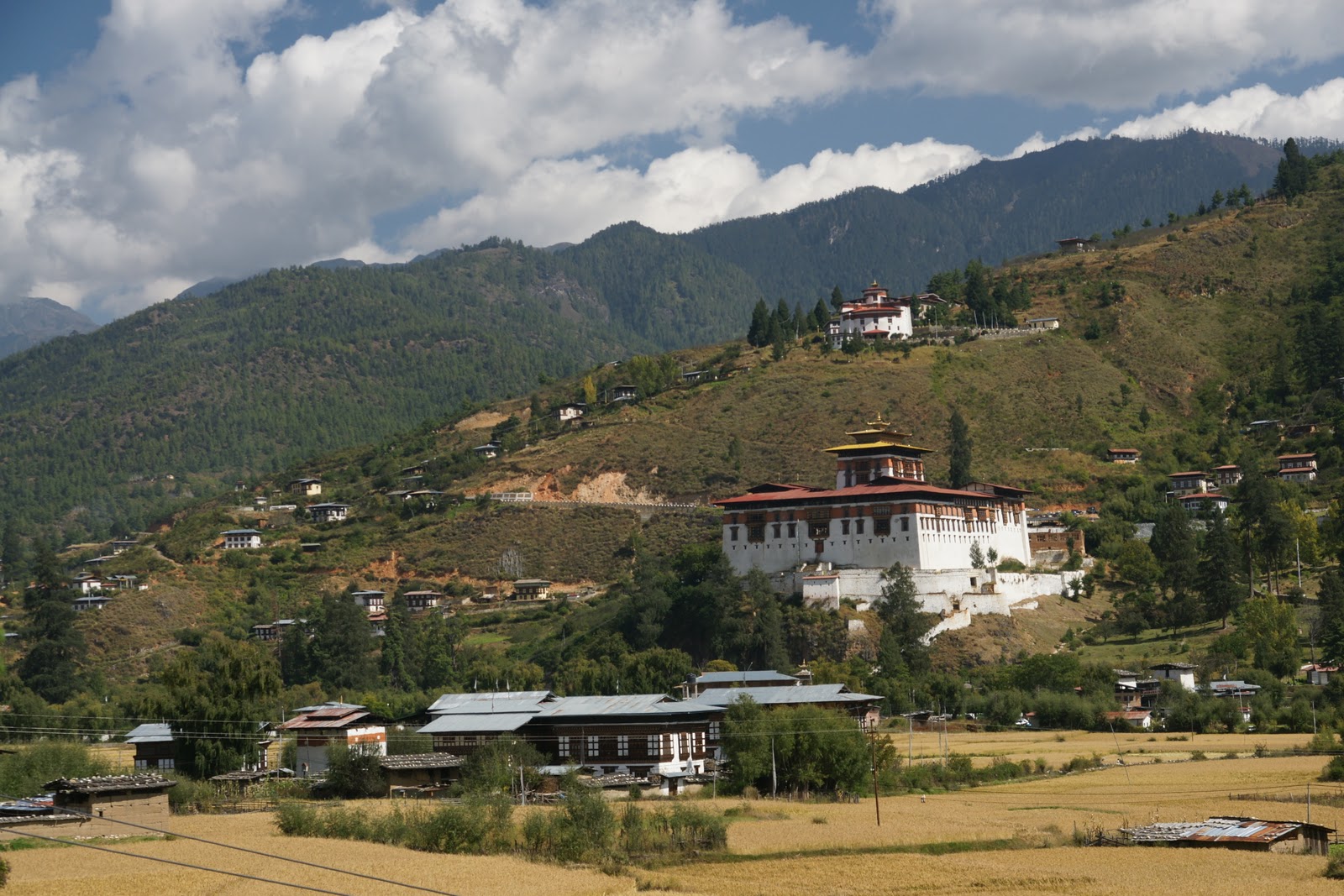
Dzong in Bhutan
We woke up in Bangkok at 3 a.m. for the drive from our hotel to the Bangkok airport, allowing extra time for traffic and the potential of flooding on the roads. Photos in the Manila newspapers the day before showed extensive flooding on all sides of the city of Bangkok because of unprecedented rains.  Our hotel, which we had selected for its proximity to the airport, had sandbags around the perimeter and, curiously, around the wine bar on the lower level. Priorities!

But the reports of flooding at the airport proved false; the flooded airport was actually the old one, not the new one built in 2006 on drained marsh. Back in 2007 when we landed there, the runway had started sinking under the weight of the planes so we were naturally concerned about our flight to Bhutan given that the runways were built on lowlands.

Sandbags in wine bar
Fortunately millions of dollars had been spent building drainage canals, large runoff reservoirs and supplemental pumping stations, and our airport was dry. More importantly our hotel was outside of the flooded areas and we had no problems there either. The trip to the airport was fast and dry, especially at that time of the morning.

Our original itinerary had us flying into Bangkok for one night and then going north to visit the ruins in Ayuthaya. We had missed the ruins on our previous two visits to Thailand. But fate was good to us this trip and our difficulties in getting a flight out of Hawaii forced us to take a flight via Manila. So we figured we might as well spend some time on Boracay Island instead of spending those five days visiting ruins. We ended up loving the beach time on Boracay and we thus avoided the flooding which hit Ayuthaya. Sometimes a problem turns out for the better.

Our departure from Bangkok went off as scheduled and as we circled over the city to head north, all I could see for miles was water. Everything was flooded. It looked like northern Ontario with its thousands of lakes and rivers. Looks like we got out just in time.

Our luck continued at check-in as we were able to snag the last two seats on the left side of the plane. These, we had been told, would give us the best views of Mt. Everest as we flew north to Bhutan.

Sure enough, the pilot announced the peaks were coming up and there it was, the highest mountain in the world in all its snow-covered glory. Flying above the clouds we had a perfect view of the majestic Mt. Everest for at least five minutes. What a sight!

Downtown Paro
Landing in Paro, Bhutan, was even more exciting. Paro is located in a flat, fertile valley between ranges of the Himalayas. The airport is right in the middle of the valley surrounded by tall mountains. As we neared Paro, the plane suddenly dropped down into a narrow valley and began a terrifying series of zig-zag banks and turns as the pilot carefully navigated his way between and around the tree-covered mountains. On one of his turns, the pilot dipped his wing so sharply to the left that I thought for sure he was going to clip the treetops. He came so close to the hillside that I swear I could count the needles on the pine trees. You hear tales of the flying skills of the pilots in the Yukon guiding small planes through the mountain ranges, but try doing that with a giant Airbus 330!

The daring manoeuvres continued for roughly five minutes at an excruciatingly slow speed and then the plane bounced down hard onto a very short single runway. It was one of the hardest landings I’ve ever experienced. But then I realized the pilot didn’t really have a lot of runway to work with. The rice fields at the end of the runway came up awfully fast. Apparently, they have plans to build a new airport in Bhutan’s capital Thimphu, but for now this is the only runway in the country.

What a gorgeous site for an airport, however, with dark, green tree-covered mountains on either side, towering snowcapped peaks to the north and a classic Tibetan-style “dzong” or fortress on the hillside right in front of the runway. When everyone disembarked, we all just stood in the middle of the runway and stared at the incredible scenery. I’ve never seen anyone do that before at any airport and I was surprised that no one stopped us. It turned out to be our first experience with the laid-back approach of the Bhutanese.

Paro airport
The terminal itself was done up like a Tibetan house with intricate wood carvings on columns, pastel plastered walls, and multi-hued paintings on window trims and the ends of the beams supporting the roof.

As we drove from the airport to our hotel, we happened to pass by an archery competition and stopped to admire the skill of the archers. Using high-powered, very expensive compound bows, probably bought in the U.S., the archers were hitting a target about the size of a dinner plate from over 100 meters.

Olympic archery team
Archery is Bhutan’s national sport and they take it very seriously. They dress up in the traditional flowing costume called a “gho” and chant and stomp their feet in encouragement in a ritualistic dance before each archer performs. With incredible strength, they strain to pull back the drawstring on the pulleys, aim high and let loose with a loud twang. All of the archers then shout and yell praise when someone hits the target. In turned out that we were witnessing Bhutan’s national team prepare for the Olympics.

The “gho” is a traditional robe that wraps around like a housecoat but only down to the knees. Everyone wears them, even businessmen. In fact, it’s the equivalent of a uniform or a suit back home and it is considered necessary attire for business meetings. A coloured sash called a “Kira” wraps around the waist and black knee-high stockings complete the outfit. It’s worn in all seasons and must be cold in winter.

Women wear the same robe, but it goes right down to the ankles. On top, a silk jacket is usually worn.

So here we are high in the Himalayas only 24 hours after leaving hot, steamy Manila. Overnight we've gone from sea level to 2,200 meters, from soft yellow sand to hard black rock hiking trails, from 30 C to 15 C (actually 4C at night).

The cold isn’t a problem; it’s actually a bit of a relief. And we have the right clothes. That’s one of the reasons our suitcases weigh so much. We’ve had to pack for all four seasons on this extended trip.

No, the problem is we’re downright exhausted. At first we thought we were just tired from our 3 a.m. rising and all of the travel over the last two days. But when we started sucking air climbing up the steep hill to our villa above the hotel, we started to worry. Then Carolann pointed out that we were now at 2,200 meters above sea level. Whoa, slow down, this isn’t the beach anymore!

It’s all quite a shock to the system, but Bhutan is a country you can only visit on their schedule so we had to take one of the few dates that they offered us. Access to this country is almost by invitation and is very limited. They are trying to avoid the mistakes of overdevelopment that other countries like Thailand have experienced.

They charge a premium to allow you to come in and only started to allow foreign tourists to visit back in 1974 with a daily fee of $40. Their objectives are to protect their culture and the environment. Now the fee is $250 per person per day and that does limit the number of tourists who can visit.

The fee seems high, but it includes the flight in from Bangkok, the exit flight, all accommodation, all meals, admissions to all sites, a car and driver, and a guide. Itineraries are custom designed to suit your interests and can be modified as you go along.

This policy of limited access seems to work. There are no backpackers, no campers, and no crowds. As someone put it to us, “no riff raff.”  In fact, most of the tourists we are seeing are older, mostly retired and well-heeled. Tourist sites are more likely to be crowded with local Bhutanese visiting the temples and chewing Beetlenut, or paying homage to a local relic in a shrine.

Here are some of the pleasant surprises about Bhutan. Upon arrival we noticed that the signs were in English and Bhutanese. We assumed this was just for passengers arriving at the airport, but it has been that way all over the country. The signs are in English, but the people don’t speak it.

Second, the temperature is actually quite mild all year long. While there is snow on the mountain peaks, they rarely get snow in the valleys these days. Our guide Sonam tells us that they used to get snow when he was a child but now climate change is even affecting this remote part of the world.

Third, there is little or no pollution and the air smells like sweet mountain fresh forests. The reason is partly that there is no industry here in Bhutan. Everything is imported, usually from India, its big neighbour to the south. Because the Bhutanese are Buddhist, they don’t even have any slaughterhouses. They let others do that for them and then import it.

Rice harvest
This is basically an agrarian society still. Rice fields are everywhere, even right beside the airport, in downtown Paro and beside the royal palace.

Fourth, there are dogs everywhere. They lie in the middle of the road and run around in friendly packs. The Bhutanese respect all life and make the effort to avoid them in the roadway. The packs are all over town, but are extremely docile and rarely even bark. They seem to be fed on restaurant leftovers and look quite content.

Fifth – although this wasn’t that big a surprise – the roads are terrible. Most are one and half lane at best, many are single lane and all of them are full of potholes. It makes for a bumpy ride and slow going, but that allows us to enjoy the incredible scenery all the better. I quickly learned the word for stop is “Du” so that I can jump out and take another picture of a snow-capped mountain or “dzong.”

Sharing the road
The other surprise connected to this is that they drive on the left side of the road, a custom imported from India, where they get most of their cars. This makes for some exciting encounters on the winding, single-lane mountain roads when two cars traveling in opposite directions are both trying to avoid a large pothole on a blind corner. Then, of course, there are the donkeys, dogs and cows wandering down the road. Yikes!

Sixth, while archery is the national sport, hunting is frowned upon. It’s partly the Buddhist thing and partly about conservation. They have wild pigs, deer and this weird animal called a Tarkin, their national animal, but they don’t hunt them. They also have rainbow trout in their mountain streams, but fishing is also tightly controlled and a special permit is required.

The bottom line is that the Bhutanese take conservation and preservation very seriously and this, combined with the lack of pollution, is making for a very pleasant introduction to this incredible country. Even though we’re still struggling to climb a flight of stairs, let alone a mountain trail, actual mountain climbing starts tomorrow.
Ta Dzong overlooking Paro valley